- Phone: +91 94298 24851
- Email: abhyasikamandal@gmail.com



One day or another, all of us ask: What will remain of me when I am gone? Not just in terms of money or property, but in terms of values, memories, and the difference we made in the lives of others.
Social leadership is not just about the work you do while you are alive, it is also about the fruits you offer to the world and the seeds you plant for the generations that will come after you.
Trees teach us this lesson beautifully. A mango tree doesn't eat its own fruit; the sweetness is shared with others. At the same time, inside every fruit lie seeds - potential future trees. In the same way, your leadership is not just about results today, but about ensuring continuity of impact tomorrow.
The fruits of social leadership are the visible results, the change people can see, feel, and celebrate.
Fruits are not just outcomes. They are nourishment. Fruits inspire trust, hope, and energy in others. Just like eating fruit gives strength to the body, the fruits of leadership give courage to others to dream bigger.
This is Krishna's reminder to Arjuna: Do not work for fame or reward, but when you do your karma sincerely, fruits naturally appear.
If fruits are results, seeds are continuity. Every leader's biggest gift is not just what they achieve, but the people they inspire and prepare to take the journey further.
Inside every seed is a hidden possibility of a forest. In the same way, every student, every mentee, every young professional you guide carries within them the possibility of building something even larger than you.
A trainer explains how to do something. A coach helps you do it better. But a mentor walks beside you as you discover why you are doing it at all. That's why the seed analogy fits best with mentoring, it is not just about transferring knowledge but about transferring courage, values, and vision.
When I reflect on my own journey, I see three life missions that form the core of my leadership legacy.
1. Building VIROC – The Tree Growing into a Forest
I always dreamed of creating not just a hospital but an empire of orthopaedic excellence—founded on honesty, transparency, and integrity. VIROC is that tree. It started as a small seed, watered with hard work and dedication. Today, it is a sturdy trunk, giving shelter and care to thousands of patients. For me, VIROC is not just an institution, it is proof that you can build something large without compromising values.
2. Training 300–500 Surgeons – The Seeds
My second mission is to pass on my knowledge and skills to the next generation. A surgeon's hands can heal a few thousand people in a lifetime. But if 300–500 surgeons learn the same craft and compassion, they will heal millions. These surgeons are the seeds I want to plant, seeds that will grow into trees of service amplifying the impact.
3. VIROC Dusara Bachpan Foundation (VDBF) – The Fruits
The third mission is our initiative where patients who received a second innings of life after surgery now give back to society. These are the fruits of my work. Every time a patient dances again or enjoys Garba, walks again with their grandchildren, or serves others with renewed energy, I see my fruits ripening. And these fruits carry seeds inside them too, because many of these patients become volunteers, spreading kindness forward.
Together, these three missions form my legacy: A tree, seeds, fruits, and now, a forest.
A single tree is beautiful, but a forest is powerful.
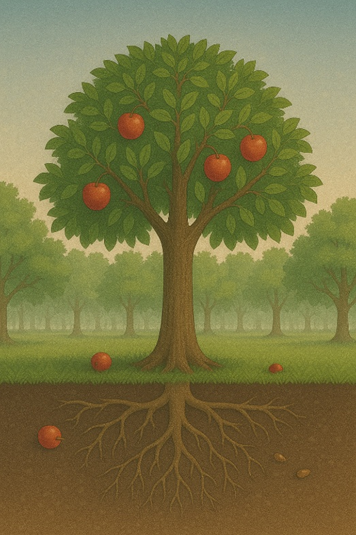
Fruits may give joy and seeds may ensure continuity—but when enough seeds grow into trees, they form a forest. A forest is more than the sum of its trees. It becomes an ecosystem where countless beings find food, shade, and protection.
In the same way, when social leaders nurture seeds and fruits across communities, they don't just create isolated acts of impact. They create ecosystems of change; networks of trust, collaboration, and compassion that thrive on their own.
A forest does not depend on one tree. It has resilience, diversity, and continuity. That is the ultimate goal of social leadership, to create such a forest of values and service that society itself becomes self-sustaining in goodness.
This simple but profound thought captures the essence of spiritual leadership. A social leader does not demand respect through loud words or flashy titles. Instead, they serve humbly—just like a tree bends to offer its fruit and shade. In everyday work, humility keeps ego in check and builds trust.
But humility does not mean weakness. In principles, a leader must stand tall and unshaken, just like the tree's trunk that refuses to bend in storms. Honesty, fairness, and compassion are not negotiable. They form the backbone of social leadership.
This balance of humility in action and firmness in values is what turns an individual into a tree of impact. Too much pride in actions dries the roots; too much compromise in values weakens the trunk. Together, humility and principles ensure stability, strength, and growth.
Pause for a moment and ask yourself:
Write your answers. Be honest. The answers may guide your next steps.
A tree never eats its own fruits. A leader never keeps the glory only for themselves.
Let your leadership be that endless effort. Fruits for today, seeds for tomorrow, forests for generations. One final message that I would want you to remember always from The Bhagavad Gita.
So, watch your actions when you start to lead, as people will follow it. And, even if a small number of people get inspired from you to follow the path of values, you have done your part.
Thank you for being a part of the Social Leadership journey; from seed to tree and forest. Wishing you the best in your own path of leadership.
* * *